Neem Karoli Baba: The Real Story Behind Hanuman Ansh (And Why It Matters for Your Kids)

If you’re an Indian parent living abroad, chances are Hanuman Ansh has come up in your family group chat lately. The devotional drama had a slow start in Indian theatres back in August, then quietly built into one of the year’s biggest word-of-mouth successes — and it’s now playing worldwide, reaching NRI families across the US, UK, Canada, Australia, and beyond.
But here’s the question most kids ask after the credits roll, and most parents don’t quite know how to answer: who was this man, really?
The film gives you two and a half hours. The real story is worth a little longer.
Who Was Neem Karoli Baba?
Neem Karoli Baba — also known as Maharaj-ji — was a Hindu spiritual teacher and a lifelong devotee of Lord Hanuman. He was born Lakshman Narayan Sharma around 1900 in a small town in Uttar Pradesh. Like a lot of real spiritual histories, his early life isn’t neatly documented — even his own devotees describe it as difficult to pin down.
What is agreed on is the shape of his path: he left home as a young man to live as a wandering sadhu, was eventually persuaded back into family life, and later returned again and again to a spiritual calling that ultimately defined him. He spent decades moving between small ashrams across North India, teaching not through formal discourse but through presence — sitting with people, feeding them, and quietly working through what devotees describe as small, unexplainable acts of grace.
He passed away in Vrindavan in 1973. What he left behind wasn’t a book of philosophy. It was a collection of stories and simple teachings, carried forward by the people whose lives he touched — which is exactly the kind of oral, story-based tradition Hindu spirituality has always passed down through generations, long before anyone wrote it down.
Why Is He Connected to Lord Hanuman?
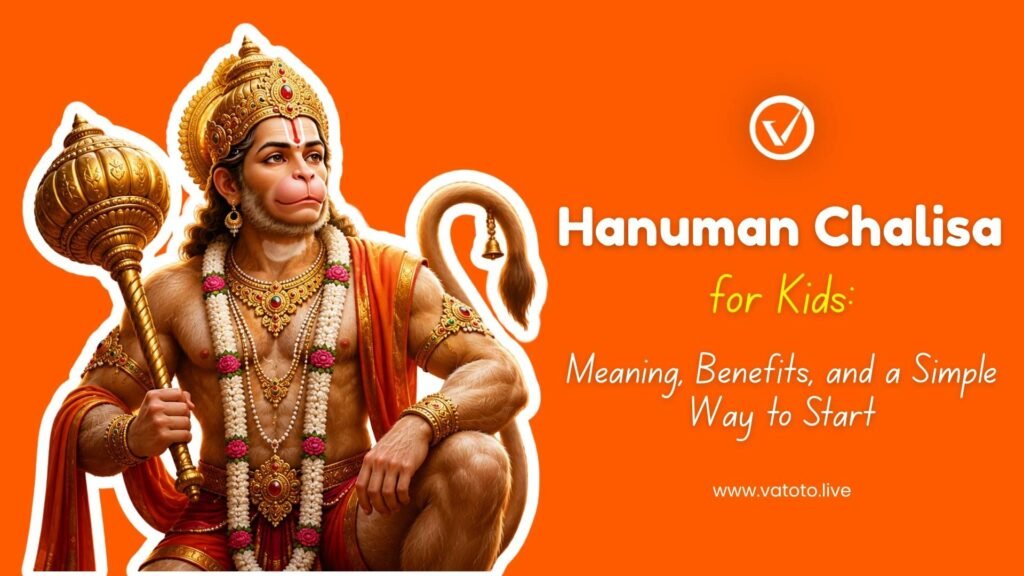
This is the part that makes his story so relevant to what we teach at Vatoto. Neem Karoli Baba is widely regarded by devotees as an incarnation of Lord Hanuman himself — a saint whose entire life modeled the very qualities the Hanuman Chalisa asks us to embody: humility, unwavering devotion, and service without expectation of reward. It’s less that he asked people to worship Hanuman, and more that he seemed to live Hanuman’s qualities so visibly that his followers connected the two.
Kainchi Dham: The Ashram That Became a Pilgrimage
If Neem Karoli Baba has a home in popular memory, it’s Kainchi Dham — a small ashram tucked into the Kumaon hills near Nainital, Uttarakhand, roughly 38 kilometres from the town. The name comes from the scissor-like (“kainchi”) shape formed by the two hills the ashram sits between.
Kainchi Dham was built during Baba’s lifetime in the 1960s, but its story didn’t end with his death in 1973. It kept traveling — carried first by his Indian devotees, and then, in an unexpected turn, by a Harvard psychologist who arrived from America.
How the Story Reached the West
Before he became known as Ram Dass, he was Richard Alpert — a Harvard researcher who had studied psychedelics alongside Timothy Leary before losing his academic position. In 1967, restless and searching, Alpert traveled to India and met Neem Karoli Baba. The encounter reshaped the rest of his life. Baba gave him the name Ram Dass, meaning “servant of God,” and Alpert went on to become one of the most influential Western teachers of Indian spiritual thought — introducing an entire generation of Americans to ideas like seva and present-moment devotion.
That thread is also how the story eventually reached Silicon Valley. A young Steve Jobs traveled to India specifically hoping to meet Neem Karoli Baba, arriving just months after Baba had passed — but the trip still shaped the simplicity and focus Jobs later brought to building Apple. Mark Zuckerberg visited the same ashram years later during a difficult stretch for Facebook, reportedly on Jobs’ advice. Julia Roberts, cricketer Virat Kohli, and actress Anushka Sharma have all spoken publicly about his influence as well.
It’s a genuinely useful thing for kids to hear: the same values behind a prayer they recite every week also shaped some of the most recognizable names in the world.
What the Movie Doesn’t Have Time to Show
A single film can only do so much. What Hanuman Ansh can’t fully capture is how these teachings actually get passed down — not through one dramatic scene, but through daily, repeated practice: a child learning to recite the Hanuman Chalisa with real understanding of what each line means, rather than just memorized sound.
That gap — between watching a story and actually living its values — is exactly where parents have the most influence, and exactly where we try to help.
A Few Questions Kids Often Ask (And How to Answer Them)
Was Neem Karoli Baba really Hanuman?
Most devotees don’t claim it as literal fact so much as a way of describing how completely his life reflected Hanuman’s qualities — devotion, humility, and selfless service. It’s a good moment to explain that in Hindu tradition, this kind of recognition often comes from a person’s actions, not a title they claim for themselves.
Why did famous people like Steve Jobs travel so far to see him?
Because the questions Baba’s teachings answer — how to find focus, purpose, and peace — aren’t really about religion at all. They’re questions everyone eventually asks, wherever they grow up.
Can we visit Kainchi Dham?
Yes — it remains an active ashram and pilgrimage site near Nainital, open to visitors, and many NRI families plan a visit when traveling back to India.
Bringing It Home for Your Kids
If your child came out of Hanuman Ansh asking questions, that curiosity is worth nurturing while it’s fresh. A few simple ways to build on it:
- Read one verse of the Hanuman Chalisa together and talk through what it actually means, rather than reciting it end to end
- Ask your child what “seva” (selfless service) could look like in their own life this week
- Watch a short video together on Kainchi Dham to make the geography and history feel real, not just mythological
Our live, teacher-led Hanuman Chalisa classes for kids go verse by verse for exactly this reason — so children don’t just memorize the chant, they understand the devotion and seva behind it, the same qualities that shaped the story they just watched.
And if the film sparked a broader interest in Hindu scripture, our Bhagavad Gita classes for kids offer the same live, story-first approach for children ages 4–16, wherever in the world you’re raising them.
A movie can spark the question. What your child does with that question next, is up to you.