Dhanteras for Kids: The Story, Meaning and Values Behind the Festival
Ask a child what happens on Dhanteras, and the answer may be simple: “We clean the house and buy something new.”
That is certainly part of the celebration. Shops sparkle with rows of diyas, families bring home new utensils, and gold and silver are considered auspicious purchases. Yet Dhanteras is about much more than shopping.
Behind the preparations lies an extraordinary story of an ocean being churned, a divine physician appearing with the nectar of immortality, and a reminder that the greatest form of wealth is not something kept in a cupboard or a bank account. It is good health, a peaceful home, wise choices and gratitude for what a family already has.
This guide to Dhanteras for kids explores the festival through its stories, symbols and traditions. It can help children understand not only what families do on Dhanteras, but why the day continues to hold such a special place in the Diwali season.
What Is Dhanteras?
Dhanteras marks the beginning of the five-day Diwali festival in many parts of India. It falls on the thirteenth lunar day, or Trayodashi, of the Krishna Paksha in the Hindu month of Kartik.
The name combines two words:
- Dhan means wealth or prosperity.
- Teras refers to the thirteenth lunar day.
For this reason, Dhanteras is often associated with welcoming prosperity into the home. Families clean and decorate their surroundings, light diyas, offer prayers and purchase something useful or valuable.
However, the meaning of dhan can be much wider than money. Health is wealth. Knowledge is wealth. A loving family, a peaceful mind and the ability to help others are also forms of prosperity.
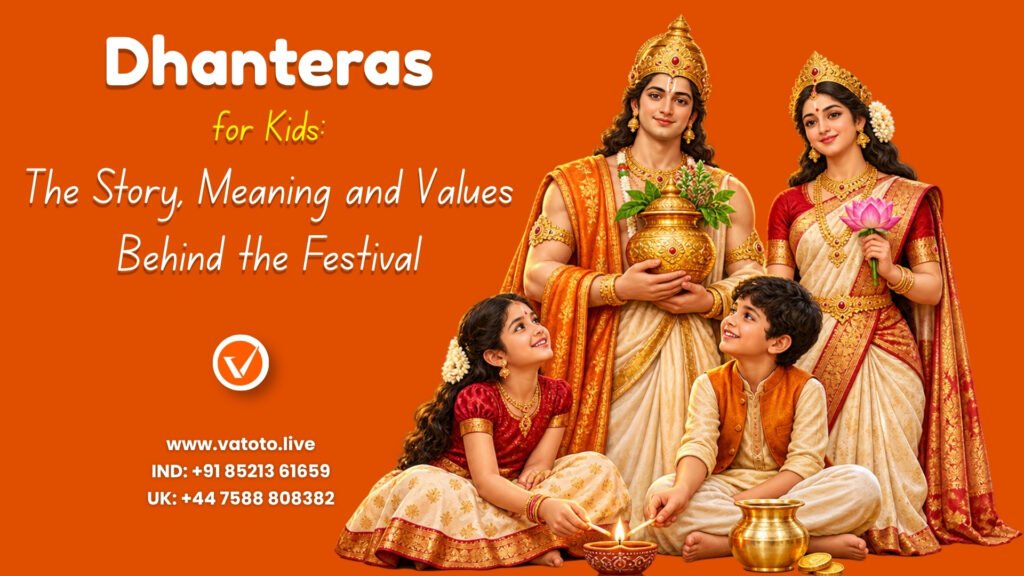
Dhanteras is also observed as Dhanvantari Jayanti, honouring Lord Dhanvantari, the divine physician associated with Ayurveda, healing and well-being. His appearance during the Samudra Manthan gives the festival one of its most important stories.
The Story of Dhanteras: When the Ocean Was Churned
Long ago, according to Hindu tradition, the devas and asuras were searching for amrit, the nectar of immortality.
Neither side could obtain it alone. They agreed to work together and churn the vast Kshira Sagara, the Ocean of Milk. Mount Mandara became the churning rod, while Vasuki, the king of serpents, served as the rope.
The task was enormous.
As the ocean was churned, many extraordinary things emerged from its depths. Some were beautiful and precious. Others brought unexpected danger. This part of the story carries an important message: when people begin a difficult task, they cannot always predict what will appear along the way.
Among the divine beings who emerged was Goddess Lakshmi, the goddess of prosperity, abundance and auspiciousness. Her appearance is one reason families worship Goddess Lakshmi during the Diwali season.
Then Lord Dhanvantari rose from the ocean carrying a kalash containing amrit. He is honoured as the divine physician and is closely associated with Ayurveda and the protection of health.
This moment lies at the heart of the Dhanteras story for children. Lord Dhanvantari did not emerge carrying jewellery, coins or a crown. He appeared with something that represented life and well-being.
That detail changes how children can understand the festival. Dhanteras may involve buying something new, but its deeper message is that a healthy life is one of the most valuable blessings a person can receive.
The Government of India’s information on Dhanvantari and the tradition of Ayurveda also explains his longstanding association with health and holistic well-being.
Why Is Goddess Lakshmi Worshipped on Dhanteras?
Goddess Lakshmi represents prosperity, abundance, good fortune and harmony. Because she emerged during the Samudra Manthan, she is remembered throughout the Diwali celebrations, including Dhanteras.
But prosperity in Indian tradition is not simply the possession of money. Wealth is considered meaningful when it is earned honestly, used wisely and shared generously.
A large house may be wealthy in appearance, but if it is filled with anger and selfishness, it does not feel truly prosperous. A simpler home filled with affection, gratitude and generosity may possess a richer kind of abundance.
This is a valuable distinction for children growing up in a world where success is often measured by what someone owns.
Goddess Lakshmi’s presence can be explained as a reminder to keep both the home and the heart ready for goodness. Cleaning the house becomes more than removing dust. It can also represent clearing away carelessness, unnecessary arguments and habits that prevent peace from entering family life.
Lord Dhanvantari and the Meaning of True Wealth
Dhanteras brings two forms of prosperity together: Goddess Lakshmi represents abundance, while Lord Dhanvantari represents health and healing.
The two belong together. Money can provide comfort and security, but it cannot replace physical well-being, emotional balance or a peaceful mind.
Lord Dhanvantari’s kalash offers families an opportunity to discuss questions that are often forgotten during festival shopping:
- Are family members taking care of their health?
- Are meals nourishing as well as enjoyable?
- Is everyone getting enough rest?
- Is the family making time to speak and listen to one another?
- Can some of the family’s prosperity be used to help someone else?
These conversations do not have to become serious lectures. A child can understand the idea through one simple sentence:
“Dhanteras reminds us that the best wealth is the kind that helps us live well and do good.”
What Do the Main Dhanteras Symbols Mean?
Children often remember a festival more easily when they understand the objects they see around them.
| Dhanteras symbol | Traditional meaning | A simple lesson for children |
|---|---|---|
| Kalash | Lord Dhanvantari’s appearance with amrit | Protect and value good health |
| Diya | Light, hope and protection | One good action can brighten a home |
| Gold or silver | Prosperity and lasting value | Use wealth carefully and responsibly |
| New utensils | Nourishment and a fresh beginning | Be grateful for food and family meals |
| Broom | Cleanliness and the removal of stagnation | Take care of the spaces you use |
| Rangoli | A joyful and auspicious welcome | Create beauty with patience and care |
| Goddess Lakshmi’s footprints | Welcoming prosperity into the home | Make the home welcoming through kindness |
| Dhanvantari’s herbs and kalash | Healing and Ayurveda | Healthy habits are a form of wealth |
The meaning of these symbols can vary between regions and family traditions. Children do not need to memorise every explanation. Understanding even two or three symbols can make the celebration feel more meaningful.
Why Do Families Buy Gold, Silver or Utensils?
Purchasing something new on Dhanteras is considered auspicious. Some families buy gold or silver, while others bring home a new utensil, appliance, broom or another useful household item.
This custom symbolises welcoming fresh prosperity and making a positive beginning.
For children, however, the focus should not become “Dhanteras means buying expensive things.” A small steel bowl can carry the same symbolic meaning as a costly ornament when it is purchased with gratitude and used with care.
The custom can teach three useful ideas.
First, value does not always depend on price. Second, objects should be purchased thoughtfully rather than wastefully. Third, prosperity comes with responsibility. If something is brought into the home, it should be cared for and used well.
A family can make the purchase meaningful by asking the child:
“How will this new item help our family?”
That question moves the conversation from owning to using, and from excitement to appreciation.
The Story Behind Yama Deep Daan
Another popular tradition associated with Dhanteras is Yama Deep Daan—lighting a diya for Yamraj, the deity connected with death and justice.
A widely told folk story speaks of a young prince whose life was predicted to end shortly after his marriage. On the appointed night, his clever and devoted wife refused to give in to fear.
She placed lamps around the entrance of their home and arranged her jewellery and coins in shining piles. She stayed awake, telling stories and singing songs.
When Yamraj’s messenger arrived, the brilliance of the lamps and jewellery made it difficult to enter. The messenger listened to the stories and remained outside until the dangerous time had passed. The prince was protected.
Families retell this legend in different ways. It is traditionally connected with placing a diya near the entrance of the home, often facing south, as a prayer for protection and the well-being of family members.
Children can take a gentle lesson from this story without becoming frightened by its subject. The prince’s wife responded to a difficult situation with courage, intelligence and presence of mind. She did not spend the night panicking. She thought carefully and did what she believed would protect someone she loved.
Dhanteras Is Not Only About Money
Modern advertisements can make Dhanteras appear like a festival created for shopping. Gold, jewellery, cars, appliances and festive offers dominate the days before Diwali.
Shopping may be part of the celebration, but it is not the entire meaning of Dhanteras.
The festival asks a more thoughtful question:
What makes a life genuinely prosperous?
For one family, prosperity may mean having enough food and a safe home. For another, it may mean recovering from illness. It might be the opportunity to learn, the support of grandparents, the arrival of a new family member or the ability to help someone through a difficult period.
Children benefit from hearing that money matters, but it is not the only measure of a good life.
The richest person in a room is not necessarily the one with the most expensive belongings. It may be the person who is healthy, content, dependable and generous.
This understanding fits naturally with values-based learning for children, where cultural traditions become starting points for real conversations about character and everyday choices.
Meaningful Ways to Celebrate Dhanteras as a Family
Dhanteras can be meaningful without becoming complicated or expensive.
Clean One Shared Space Together
Instead of asking children to clean the entire house, give them ownership of one small area—a bookshelf, prayer space, study table or family corner.
Explain that preparing a clean space is a way of showing care. The aim is not perfection. It is participation.
Light a Diya for Health
After lighting the diya, each person can name one healthy habit they would like to strengthen. A child might choose drinking more water, sleeping on time, playing outdoors or eating fruit regularly.
This connects Lord Dhanvantari’s story with something children can actually practise.
Create a Family Wealth Jar
Give “wealth” a wider meaning. Each person can write or draw one blessing and place it inside a decorated jar.
The slips might say:
- My grandparents
- Good health
- My school
- A friend who helps me
- Food at home
- Stories with my family
- The chance to learn
Reading these together can help children see how much wealth already exists around them.
Buy Something Useful
If the family follows the tradition of purchasing a new object, let the child help choose something the household genuinely needs.
It could be a utensil, a plant, a book, a diya or an item that supports a healthy habit. The purchase does not have to be expensive to be auspicious.
Share With Someone
Set aside food, clothes, books or a small amount of money for someone who may need support.
Children understand generosity most clearly when they participate in it. Let them pack the items, write a kind note or help decide what would be useful.
Tell the Samudra Manthan Story
The story contains everything children naturally enjoy: an ocean, a mountain, a giant serpent, devas, asuras, danger, treasures and the appearance of divine beings.
After sharing it, ask:
“Why do you think Lord Dhanvantari appeared with healing and amrit instead of gold?”
There is no need to search for one perfect answer. The conversation itself helps the meaning stay with them.
What Can Children Learn From the Samudra Manthan?
The Samudra Manthan is not merely an explanation of how Lord Dhanvantari appeared. It also contains several ideas children can recognise in their own lives.
Important Things Require Patience
The ocean was not churned once or twice. The effort continued despite exhaustion and difficulty. Children can connect this with learning an instrument, practising a sport, reading a challenging book or working patiently on a school project.
Cooperation Can Be Necessary
The devas and asuras were opponents, yet they worked together because the task was too great for either group alone.
Children do not need to become close friends with everyone, but they can learn to cooperate respectfully when completing a shared responsibility.
Difficulties Can Appear Before Rewards
Not everything that emerged from the ocean was pleasant. The story shows that difficult moments may arise before a valuable result becomes visible.
This does not mean suffering always guarantees a reward. It means that the appearance of a problem does not automatically mean the effort has failed.
Health Is a Form of Prosperity
Lord Dhanvantari’s emergence places well-being at the centre of Dhanteras. It gives children a definition of wealth that is larger and healthier than simply having more possessions.
Wealth Should Be Used Wisely
Goddess Lakshmi represents prosperity, but prosperity should be accompanied by responsibility. What matters is not only what a person has, but what they do with it.
Dhanteras for Children Growing Up Abroad
For children in the USA, UK, Canada, Australia, the UAE and elsewhere, Dhanteras may not be visible outside the home. Their classmates may know about Diwali but have never heard of the festival that begins the celebrations.
A child does not need a long speech to explain it. A simple answer is enough:
“Dhanteras is the first day of the Diwali festival. Families pray for health and prosperity, remember Lord Dhanvantari, clean their homes, light diyas and often buy something useful or valuable.”
When children understand the story behind a tradition, they can speak about it with confidence. The festival stops feeling like a collection of unfamiliar rituals and becomes part of a heritage they can explain in their own words.
Families raising children overseas may also find these suggestions for helping children stay connected with Indian culture useful.
From Dhanteras to Diwali
Dhanteras opens the doorway to the larger Diwali celebration. It begins with preparation: cleaning the home, thinking about health, using wealth wisely and welcoming auspiciousness.
The days that follow carry other traditions, including Narak Chaturdashi, Lakshmi Puja, Govardhan Puja and Bhai Dooj, although customs differ across regions and communities.
Together, these celebrations remind families that light is not only something placed in a diya. It can appear as wisdom, courage, kindness, health and renewed hope.
You can continue the festival journey with this guide to Diwali for kids, which explores the return of Shri Ram to Ayodhya and the values children can learn from the Festival of Lights.
Frequently Asked Questions About Dhanteras
Why is Dhanteras celebrated?
Dhanteras marks the beginning of the Diwali festival and is associated with prosperity, health and auspicious new beginnings. It also honours Lord Dhanvantari, who is traditionally believed to have emerged during the Samudra Manthan carrying a kalash of amrit.
What is the meaning of Dhanteras?
The word combines dhan, meaning wealth, with teras, referring to the thirteenth lunar day. Its deeper meaning includes not only financial prosperity but also health, gratitude, peace and family well-being.
Who is Lord Dhanvantari?
Lord Dhanvantari is honoured as the divine physician and is associated with Ayurveda, healing and health. His appearance with the amrit kalash during the Samudra Manthan is remembered on Dhanteras.
Why do people buy utensils on Dhanteras?
Buying a new utensil is considered an auspicious way to welcome prosperity and a fresh beginning. Utensils also represent nourishment, food and care for the family.
Is buying gold compulsory on Dhanteras?
No. Families may buy gold, silver, utensils, a broom or another useful object, but no expensive purchase is compulsory. The intention behind the tradition is more important than the price of the item.
Why are diyas lit on Dhanteras?
Diyas symbolise light, hope and protection. Some families also observe Yama Deep Daan by placing a diya near the entrance of the home as a prayer for the safety and well-being of family members.
How can I explain Dhanteras to a child?
You can say:
“Dhanteras is the first day of Diwali. We remember Lord Dhanvantari, pray for health and happiness, clean our home, light diyas and feel thankful for the good things in our lives.”
Is Dhanteras only about Goddess Lakshmi?
Goddess Lakshmi is worshipped for prosperity, but Dhanteras is also closely associated with Lord Dhanvantari and the value of health. Regional customs may place greater emphasis on one tradition or another.
The Richest Dhanteras Gift
Children may remember the shining diyas, the rangoli near the entrance or the excitement of bringing something new into the house. As they grow older, however, the deeper meaning of Dhanteras can grow with them.
They can learn that prosperity is not simply having more.
It is having enough and knowing how to be grateful. It is caring for one’s health before illness makes it impossible to ignore. It is using money with wisdom, sharing with generosity and creating a home where people feel safe and valued.
That is why the Dhanteras story for children still matters. Lord Dhanvantari’s kalash reminds families that life and well-being are precious. Goddess Lakshmi reminds them that abundance should bring harmony rather than greed. The glowing diya reminds them that even a small light can change the feeling of an entire room.
Vatoto.live helps children aged 4–16 discover Indian stories, shlokas and values through warm, live online learning. Through Geeta Sparks and Chalisa Champs, children explore timeless wisdom in a way that feels engaging, understandable and connected to everyday life.
Book a free demo class and help your child build a joyful, lasting connection with Indian culture.
Wishing your family a healthy, peaceful and truly prosperous Dhanteras.