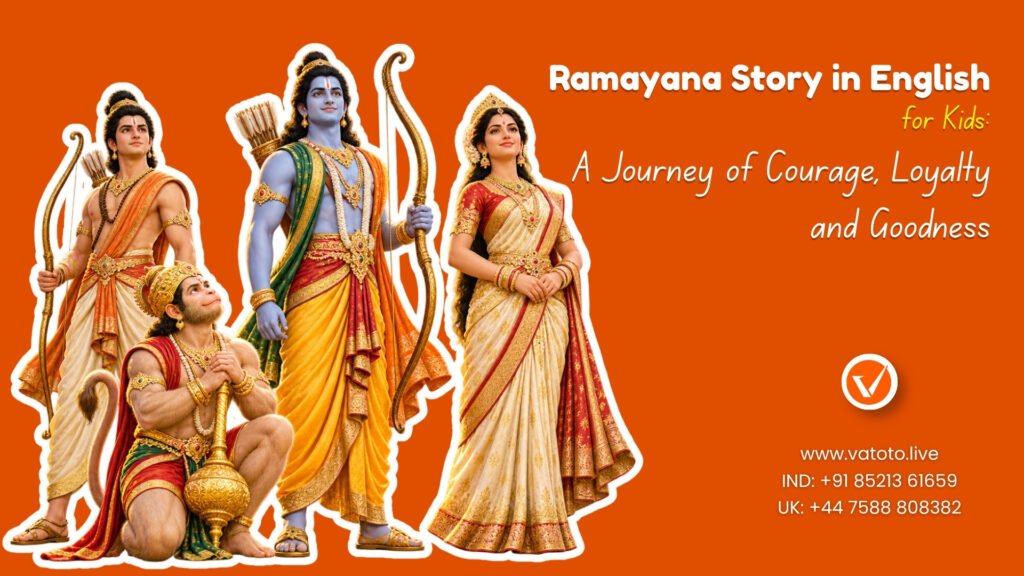
Ramayana Story in English for Kids: A Journey of Courage, Loyalty and Goodness
Some stories entertain children for an afternoon. Others stay with them for life.
The Ramayana belongs to the second kind. It has brave princes, a courageous princess, enchanted forests, a devoted warrior who can cross an ocean, and a powerful king whose pride becomes his greatest weakness. Yet beneath every adventure lies a question children still face today: What should I do when the right choice is difficult?
This Ramayana story in English introduces children to Shri Ram, Mata Sita, Lakshman Ji, Hanuman Ji and the many other unforgettable people whose decisions shape the epic. It is not only a story about the victory of good over evil. It is a story about keeping promises, staying hopeful, using strength responsibly and choosing goodness even when no one is watching.
For children growing up in India or abroad, the Ramayana can also become a warm connection to their cultural roots—one story that brings together family, faith, language and values.
What Is the Ramayana?
The Ramayana is one of India’s great epics. The ancient Sanskrit work known as the Valmiki Ramayana is traditionally attributed to Maharishi Valmiki. Over the centuries, the story has been retold in many Indian languages and across different parts of Asia.
These retellings sometimes vary in their smaller details, but the heart of the story remains the same: Shri Ram’s journey from Ayodhya into exile, the abduction of Mata Sita by Ravan, Hanuman Ji’s remarkable devotion, and the struggle to restore truth and justice.
A short Ramayana summary may describe it as a battle between Shri Ram and Ravan. But that battle is only one part of a much richer story. The Ramayana asks what it means to be a good child, sibling, friend, leader and human being. Its heroes are remembered not simply because they were powerful, but because of how they used their power.
Meet the Main Ramayana Characters
Before beginning the story, it helps children understand the main Ramayana characters and what makes each of them important.
| Character | Place in the story | Quality children can notice |
|---|---|---|
| Shri Ram | Prince of Ayodhya and eldest son of King Dasharath | Integrity, courage and responsibility |
| Mata Sita | Princess of Mithila and wife of Shri Ram | Inner strength, dignity and faith |
| Lakshman Ji | Shri Ram’s devoted younger brother | Loyalty, alertness and service |
| Bharath | Shri Ram’s younger brother | Selflessness and respect |
| Hanuman Ji | Devotee of Shri Ram and a mighty vanar warrior | Courage, humility and devotion |
| King Dasharath | King of Ayodhya and father of the four princes | Love, duty and the weight of a promise |
| Kaikeyi | Bharath’s mother and one of King Dasharath’s queens | The consequences of fear and poor advice |
| Ravan | Powerful king of Lanka | Great ability weakened by pride |
| Jatayu | Elderly bird who tries to protect Mata Sita | Bravery and sacrifice |
| Vibhishan | Ravan’s brother who chooses the side of dharma | The courage to oppose wrongdoing |
| Sugriv | Vanar king who becomes Shri Ram’s ally | Friendship and cooperation |
These characters are not interesting merely because they are part of an ancient tale. Each one reveals something about human nature. Some show how goodness becomes stronger through patience and humility, while others show how intelligence and power can be ruined by ego.
A Prince Loved by Ayodhya
Long ago, the kingdom of Ayodhya was ruled by King Dasharath. He had four sons: Ram, Bharath, Lakshman and Shatrughna. The brothers were deeply attached to one another, but the bond between Ram and Lakshman was especially strong.
As the eldest prince, Shri Ram was expected to become king one day. He was admired for his calm nature, courage and fairness. He listened carefully, treated people with respect and never used his position to make others feel small.
When Sage Vishwamitra asked King Dasharath to send Ram to protect sacred ceremonies from those who were disturbing them, the king hesitated. Ram was still young, and Dasharath worried about his safety. Yet Shri Ram accepted the responsibility, and Lakshman Ji accompanied him.
During this journey, the brothers faced danger, learned from a wise teacher and saw that courage was not the absence of fear. It was the decision to do what was necessary despite fear.
The Bow of Lord Shiva and the Ram Sita Story
The brothers later travelled to Mithila, where King Janak had arranged a swayamvar for his daughter, Sita.
A magnificent bow associated with Lord Shiva stood in the royal court. The challenge before the assembled princes was to lift and string it. Many powerful rulers tried but could not move it.
When Shri Ram approached the bow, he did not boast or mock those who had failed. With Sage Vishwamitra’s permission, he lifted it—and as he attempted to string it, the great bow broke.
Shri Ram and Mata Sita were married, beginning one of the most cherished relationships in the Indian tradition. At the heart of the Ram Sita story is more than a royal marriage. Their journey shows companionship through comfort, uncertainty, separation and struggle.
Mata Sita is sometimes introduced to children only as someone who needed to be rescued. That description misses much of her strength. She left palace life willingly to accompany Shri Ram into the forest. Later, while imprisoned in Lanka, she refused to surrender to fear or temptation. Her courage was quiet but unshakable.
The Promise That Changed Everything
Years later, King Dasharath decided that Shri Ram should become the next king of Ayodhya. The entire city prepared for the celebration.
But before the ceremony, Kaikeyi was reminded of two promises King Dasharath had once made to her. Influenced by fear and harmful advice, she asked that Bharath be crowned instead and that Ram be sent into the forest for fourteen years.
The request broke Dasharath’s heart. He had not expected his old promises to be used in this way, but he believed he could not dishonour his word.
Shri Ram could have argued. The people of Ayodhya supported him, and he had done nothing wrong. Instead, he calmly accepted the exile to protect his father’s honour.
This is one of the Ramayana’s most difficult moments. It allows children to see that doing the right thing does not always feel fair or lead to an immediate reward.
Mata Sita chose to accompany her husband. Lakshman Ji also refused to remain behind. The three exchanged palace comfort for forest paths, simple shelters and an uncertain future.
Bharath’s Refusal to Take What Was Not His
Bharath was away when these events unfolded. When he returned and learned what had happened, he was horrified. He had never asked for the throne and refused to benefit from an unfair decision made in his name.
He travelled into the forest and begged Shri Ram to return to Ayodhya. Ram, however, believed that their father’s promise still had to be honoured.
Bharath did not respond with anger or try to seize power. Instead, he took Shri Ram’s padukas back to Ayodhya and placed them on the throne as a symbol that Ram remained the rightful king. Bharath governed only as his brother’s representative while waiting for his return.
In a story filled with dramatic adventures, Bharath’s decision can easily be overlooked. Yet it is one of the finest examples of selflessness in the epic. He had the opportunity to become king, but he did not accept something that did not rightfully belong to him.
The Golden Deer and Mata Sita’s Abduction
For several years, Shri Ram, Mata Sita and Lakshman Ji lived peacefully in the forest.
Their lives changed when Mata Sita saw a beautiful golden deer near their dwelling. She asked Ram if he could bring it to her. The deer was actually Marich, who had taken this form as part of Ravan’s plan.
Shri Ram followed the deer, leaving Lakshman Ji to protect Mata Sita. Later, a cry sounding like Ram’s voice echoed through the forest. Worried for her husband, Mata Sita urged Lakshman to go and help him.
Once she was alone, Ravan approached in disguise. He revealed his true identity and carried her away to Lanka.
On the journey, the elderly bird Jatayu saw what was happening. He knew that Ravan was far stronger, but he still tried to save Mata Sita. Jatayu fought bravely and was gravely wounded.
His courage teaches an important truth: bravery is not guaranteed victory. Sometimes bravery means refusing to remain silent when another person is in danger.
The Search and an Extraordinary New Friend
When Shri Ram and Lakshman Ji returned and discovered that Mata Sita was missing, they were devastated. Their search eventually led them to Sugriv and Hanuman Ji.
Hanuman Ji approached the brothers respectfully and spoke with such wisdom that Ram immediately recognised his good character. This meeting began one of the most celebrated relationships in the Ramayana.
Hanuman Ji was immensely powerful, but his greatness came from more than physical strength. He listened carefully, thought clearly and used his abilities in service of others. He did not help Ram to gain fame. He helped because he recognised a just purpose.
The vanar sena began searching in every direction. Eventually, they learned that Mata Sita was being held across the ocean in Lanka.
The distance seemed impossible. Then Jambavan reminded Hanuman Ji of the strength he already possessed. Hanuman Ji had not lost his abilities; for a time, he had forgotten them.
With his confidence restored, he grew to a mighty size and prepared to leap across the sea.
It is a moment children often love because it is exciting, but it also holds a gentle message: sometimes a person does not need a new power. They need someone who helps them recognise the power already within them.
Hanuman Ji’s Leap to Lanka
Hanuman Ji’s journey across the ocean tested more than his strength. He faced obstacles that required patience, quick thinking and good judgment. He knew that reaching Lanka was not enough; he had to find Mata Sita without drawing attention to himself.
After searching the city, he found her in Ashok Vatika. She was surrounded by guards but remained firm in her refusal to accept Ravan’s demands.
Hanuman Ji approached carefully and gave her Shri Ram’s ring. The small ring carried a powerful message: You have not been forgotten. Help is coming.
Mata Sita gave Hanuman Ji a jewel to take back as proof that he had found her. He offered to carry her away immediately, but she chose to wait for Shri Ram to confront the injustice openly.
Before leaving Lanka, Hanuman Ji allowed Ravan’s forces to capture him so that he could deliver a warning. His tail was set on fire, but he escaped and used the flames to burn parts of Lanka. He then returned across the ocean with news of Mata Sita.
For children who are drawn to Hanuman Ji’s bravery and devotion, learning the Hanuman Chalisa for kids can introduce these qualities through verses, meanings and stories.
Building the Bridge to Lanka
Once Shri Ram knew where Mata Sita was, he and the vanar sena reached the shore of the ocean. A bridge had to be built before the enormous army could cross.
The bridge to Lanka is remembered as a great example of collective effort. No single warrior completed it alone. Every contribution mattered, from the planning of the leaders to the stones carried by members of the vanar sena.
Children often hear about the strength of one hero. The bridge reminds them that even the strongest hero sometimes needs a team.
Before the battle, Vibhishan repeatedly advised his brother Ravan to return Mata Sita and prevent unnecessary destruction. Ravan refused to listen and insulted him. Vibhishan then left Lanka and joined Shri Ram.
Turning away from one’s own family is not a small decision. Vibhishan’s choice shows that loyalty does not require supporting harmful behaviour. At times, standing for what is right means disagreeing with the people closest to us.
The Battle Between Ram and Ravan
A great battle began in Lanka.
Ravan’s army contained many formidable warriors, including his son Meghnad and his powerful brother Kumbhakarna. Shri Ram’s side included Lakshman Ji, Hanuman Ji, Sugriv, Angad, Jambavan and the vanar sena.
During the fighting, Lakshman Ji was seriously wounded. The only hope was a life-saving herb found on a distant mountain. Hanuman Ji flew to find it, but when he could not identify the correct plant, he lifted the entire mountain and carried it back.
The moment is dramatic, but the thinking behind it is equally valuable: Hanuman Ji did not allow uncertainty to stop him. When he could not solve the problem in the expected way, he found another way to complete the mission.
Eventually, Shri Ram faced Ravan.
Ravan was not an ordinary enemy. He was scholarly, disciplined and extraordinarily powerful. Yet his knowledge could not protect him from the consequences of pride, anger and the refusal to correct his actions.
Shri Ram defeated Ravan, ending Mata Sita’s captivity and restoring justice.
That victory is not a message that strength alone wins. Both sides possessed strength. The deeper lesson is that talent without character can become dangerous.
The Return to Ayodhya
After completing fourteen years of exile, Shri Ram, Mata Sita and Lakshman Ji returned to Ayodhya. Hanuman Ji and the friends who had supported them shared in their joy.
Bharath had waited faithfully and welcomed his brother home. Shri Ram was crowned king, and the kingdom celebrated the return of its rightful ruler.
This homecoming is widely associated with Diwali and the lighting of diyas. The lamps represent not only victory after battle but also hope after a long period of uncertainty.
The story ends with a celebration, yet the happiness feels meaningful because of everything that came before it: loss, patience, friendship, sacrifice and the refusal to give up.
What Does the Ramayana Teach Children?
The Ramayana does not need to be turned into a lecture. Its values appear naturally through the choices of its characters.
Shri Ram shows that leadership begins with responsibility rather than authority. Mata Sita shows that a person can remain strong even when their circumstances are beyond their control. Lakshman Ji demonstrates dedicated service, while Bharath proves that goodness sometimes means refusing an advantage.
Hanuman Ji shows children that real strength is most beautiful when combined with humility. Jatayu teaches that an individual should try to protect another person even when success is uncertain. Vibhishan shows that family loyalty should never become an excuse for supporting wrongdoing.
Ravan, meanwhile, offers a powerful warning. He possessed knowledge, wealth and ability, but he allowed pride and desire to control his decisions. The Ramayana therefore does not divide people into those who are intelligent and those who are foolish. It asks whether intelligence is guided by wisdom.
These ideas are part of values-based learning for children: helping a child connect a cultural story with real decisions at home, at school and among friends.
Helping Children Connect With the Story Naturally
Children do not need to absorb the entire epic in one sitting. The Ramayana becomes more meaningful when it is shared as a series of memorable episodes.
One evening might be about Bharath refusing the throne. Another might follow Hanuman Ji across the ocean. A family conversation could begin with a simple question: Which character made the hardest choice today?
Let children disagree. One child may admire Shri Ram’s sense of duty, while another may feel most moved by Jatayu’s courage or Mata Sita’s resilience. These different responses make the story personal.
Art, music and role-play can also bring the story to life. A child might draw the bridge to Lanka, retell the golden deer episode from Lakshman Ji’s point of view, or imagine what Hanuman Ji felt before making his leap.
For families living abroad, stories like the Ramayana can help children explain their heritage confidently. This is especially valuable when they encounter questions about Indian traditions at school. The aim is not to make them memorise a perfect answer, but to help them feel that their culture is something they understand and can share. Parents raising children overseas may also find these ideas for teaching Hindu values to kids in the USA useful.
Frequently Asked Questions About the Ramayana
1. Who wrote the Ramayana?
The ancient Sanskrit Ramayana is traditionally attributed to Maharishi Valmiki. Many poets and teachers later created regional retellings, including versions in Tamil, Awadhi, Bengali and several other languages.
2. What is the Ramayana story mainly about?
The Ramayana follows Shri Ram’s exile from Ayodhya, the abduction of Mata Sita by Ravan, the search led by Ram and his allies, Hanuman Ji’s journey to Lanka, the battle against Ravan and the eventual return to Ayodhya.
3. Who are the most important Ramayana characters?
The principal Ramayana characters include Shri Ram, Mata Sita, Lakshman Ji, Bharath, Hanuman Ji, Ravan, King Dasharath, Kaikeyi, Sugriv, Jatayu and Vibhishan. Each character contributes a different lesson about courage, loyalty, responsibility or pride.
4. Is the Ramayana only a religious story?
The Ramayana is a sacred text and an essential part of Hindu tradition. It is also studied as literature, philosophy and cultural history. Families may approach it through devotion, storytelling, values or a combination of all three.
5. Why is Hanuman Ji so important in the Ramayana?
Hanuman Ji discovers Mata Sita in Lanka, reassures her, carries her message to Shri Ram and plays a central role in the battle. He is loved for combining extraordinary strength with humility, wisdom and complete devotion.
6. How can children remember such a long story?
Begin with the main journey: Ayodhya, exile, Mata Sita’s abduction, Hanuman Ji’s leap, the battle in Lanka and the return home. Once this simple sequence is familiar, individual characters and episodes become easier to place.
7. Are all versions of the Ramayana exactly the same?
No. The Ramayana has been retold across many regions and languages, and some details differ between traditions. These variations are part of the epic’s long and living cultural history.
A Story Children Can Keep Returning To
A child may first enjoy the Ramayana because Hanuman Ji flies across the ocean or because a vast army builds a bridge to Lanka. Later, that same child may notice Bharath’s selflessness, Mata Sita’s inner strength or Vibhishan’s difficult decision to oppose his brother.
That is the lasting beauty of the Ramayana story in English or in any language: its meaning grows with the reader.
The Ramayana does not tell children that goodness always makes life easy. It shows them that goodness gives a person direction when life is difficult. Courage may look like crossing an ocean, but it can also look like telling the truth, keeping a promise, defending a friend or admitting that a decision was wrong.
Vatoto.live helps children aged 4–16 explore Indian wisdom through stories, discussion and meaningful chanting. In Chalisa Champs, children learn the Hanuman Chalisa with its meaning and connection to Hanuman Ji’s qualities. Geeta Sparks introduces Bhagavad Gita shlokas through relatable examples and thoughtful conversation.
Book a free demo class and help your child discover that India’s timeless stories are not only stories from the past—they can become guides for the choices children make today.
May the courage of Shri Ram, the strength of Mata Sita and the devotion of Hanuman Ji inspire your family.