What the Bhagavad Gita Teaches Kids About Handling Exam Stress
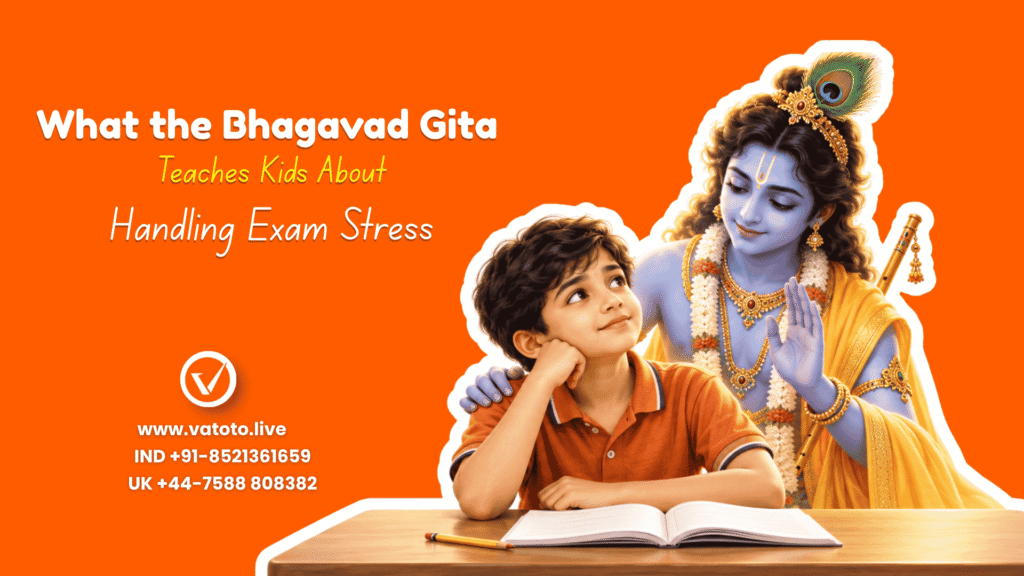
There’s a particular look kids get the night before a big exam. Somewhere between the textbook and the ceiling, you can watch the worry take over — not about the material anymore, but about what happens if it goes wrong. This is where the Bhagavad Gita’s approach to exam stress offers something most parenting advice misses.
Most parenting advice for exam stress focuses on the practical: sleep well, eat right, don’t cram, take breaks. All true, all useful, and none of it touches the actual fear underneath, which is rarely about the syllabus at all. It’s about outcome. What if I fail? What if I’m not good enough? What if everyone finds out I don’t know this?
Strangely enough, one of the clearest answers to this exact fear was written down thousands of years ago, in a conversation that had nothing to do with school at all.
The Conversation Wasn’t About Exams — But It Might As Well Have Been
The Bhagavad Gita opens with Arjuna frozen on a battlefield, overwhelmed, unable to act, paralyzed by the weight of what might happen. Krishna’s response to him isn’t “don’t worry, it’ll be fine.” It’s something more specific, and honestly, more useful: focus on your action, not on what the action produces.
“You have a right to your actions, but never to the fruits of your actions.”
Strip away the battlefield, and this is almost exactly the sentence a stressed twelve-year-old needs to hear the night before a math exam. Not “you’ll do great” — a promise nobody can actually make — but a shift in where their attention goes. From the score they can’t control yet, to the effort they can control right now.
This single idea, if a child genuinely absorbs it, does something most exam-stress advice doesn’t: it doesn’t try to talk them out of caring. It just moves their grip from the outcome to the process, which is the only part they ever actually had power over in the first place.
Why This Actually Works on Kids
Adults sometimes assume philosophy is too abstract for children. In practice, kids understand this idea faster than most adults do, because they haven’t yet learned to overthink it.
Try this framing with a child before an exam: “Your job tonight isn’t to guarantee an A. Your job is just to do the next right thing — review this one chapter, get some sleep. The result isn’t in your hands yet, but the effort is.” Most kids visibly relax when the goalpost moves from an outcome they can’t control to an action they can.
This is really what applying the Bhagavad Gita to exam stress looks like in practice — not reciting verses, but borrowing the mindset behind them.
This isn’t about lowering expectations or telling kids grades don’t matter. It’s about separating what’s genuinely in their control from what isn’t — which, it turns out, is one of the most effective anxiety-reduction techniques used in modern psychology too. The Gita just got there first.
What Modern Psychology Quietly Agrees With
It’s worth pointing out, because it makes the idea easier to trust: this isn’t just an ancient concept dressed up as parenting advice. Cognitive behavioral therapy, one of the most researched approaches to anxiety, is built on a very similar principle — identifying what’s within your control and redirecting energy there, rather than spiraling around what isn’t.
Sports psychologists tell athletes almost the exact same thing before a big match: control your preparation and your effort, not the scoreboard. Krishna was essentially coaching Arjuna through performance anxiety on a battlefield, and the underlying mechanism is the one we now recognize in exam halls, courtrooms, and job interviews alike. The context changes; the psychology doesn’t.
This mirrors core ideas in cognitive behavioral therapy, one of the most researched approaches to anxiety.
For a parent who wants to help without turning into an amateur therapist, that overlap is useful. You’re not asking your child to believe in anything. You’re handing them a genuinely effective coping tool that happens to come from your own cultural tradition, which makes it land differently than a worksheet from a school counselor might.
Using the Bhagavad Gita for Exam Stress: A Simple Practice
You don’t need to explain the entire Gita to get value from this. A few small things work better than a long talk:
Name the fear out loud. “Are you scared about the result, or about the material?” Often it’s the result. Naming it takes some of its power away, because vague dread is much harder to sit with than a specific, nameable worry.
Reframe the goal for tonight. Not “score well” but “review these three topics” or “practice ten problems.” A concrete, doable action calms a racing mind faster than a vague hope does, because it gives anxious energy somewhere to go.
One shloka, if they’re open to it. Some families find it grounding to say a single line together before a big exam — not as a superstition, but as a two-minute pause that shifts focus from panic to calm. It doesn’t have to be religious to be useful; the ritual itself does something, the same way an athlete’s pre-game routine does.
After the exam, ask about effort, not just the score. “Did you do what you could?” matters more long-term than “how do you think you did?” — it reinforces that their worth isn’t tied to the number that comes back, and it’s a question they can answer honestly regardless of outcome.
Adjusting This by Age
A six-year-old and a sixteen-year-old need this idea delivered differently, and it’s worth being deliberate about that.
For younger children (ages 5-9), keep it almost entirely in action, not explanation. Skip the philosophy altogether and just model the behavior: “Let’s do our best and then let it go” said calmly, repeated often, does more than any explanation would at this age.
For middle years (ages 10-13), this is often the sweet spot for introducing the actual idea behind it — that effort and outcome are two different things, and only one is theirs to control. Kids this age are old enough to grasp the logic and young enough that it hasn’t calcified into “that’s just how I deal with stress” yet.
For teenagers (14+), the conversation can go further — connecting it to bigger themes like identity (“I am not my grades”) and long-term resilience. Older kids often respond well to knowing this comes from a genuinely ancient text grappled with by warriors and scholars alike, not a parenting hack invented for them specifically.
This Isn’t Just for Exams
The deeper thing kids take from this, if it’s introduced early and often, is a way of relating to any outcome they can’t control — a tryout, a friendship, a performance, a college application years down the line. Exam stress is often just the first place this shows up loudly enough for parents to notice. Teaching the skill here means it travels with them well beyond school, into every high-stakes moment life eventually hands them.
Parents who’ve tried this approach often notice something else too: it changes their own relationship to their child’s results. It’s hard to stay calm about a child’s exam if you’re also gripping the outcome tightly. Modeling detachment from results, even as a parent, tends to be contagious in both directions.
Where This Fits Into What We Teach
This is exactly the kind of lesson we bring to life in our Bhagavad Gita classes at Vatoto.live — not as abstract philosophy, but through stories and conversations that connect directly to what kids are actually going through, exam season included. Children don’t need to memorize a verse to benefit from it. They need someone to make it real for them, in language that fits their age and their actual worries.
Want to see how a class does this in practice? Book a free demo class — no cost, no obligation.