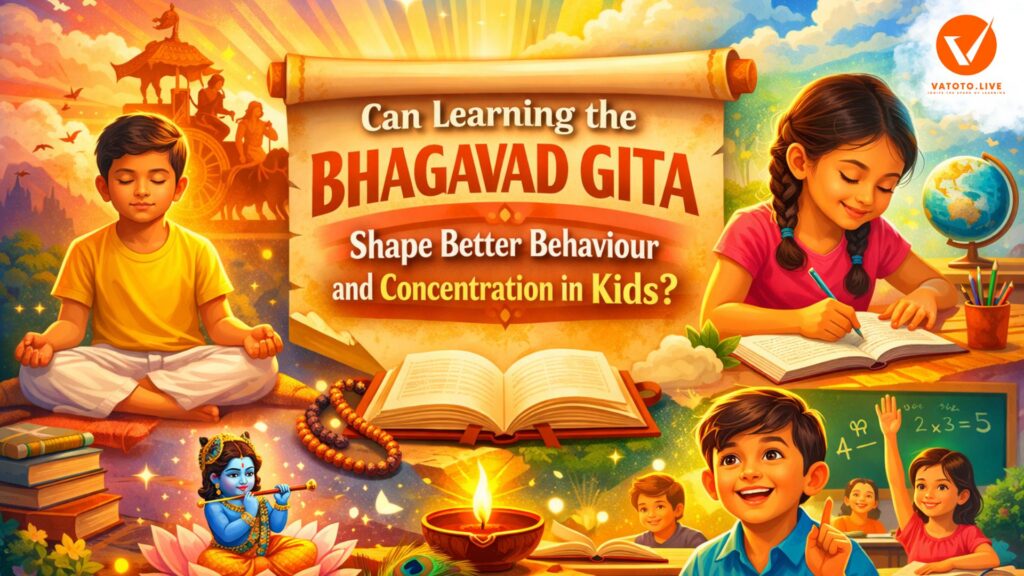
In today’s fast-paced and highly stimulating world, emotional balance has become one of the most important yet overlooked aspects of a child’s development. Parents often focus on academic performance, extracurricular achievements, and skill building, but many quietly struggle with concerns related to their child’s emotions—frequent anger, anxiety, frustration, fear of failure, or emotional withdrawal.
Children today are growing up in an environment very different from previous generations. Constant exposure to screens, social comparison, academic pressure, and packed schedules leaves little room for stillness, reflection, or emotional understanding. As a result, many children experience emotional overload without having the tools to process it healthily.
This has led parents and educators to explore approaches that nurture not just the intellect, but also the inner emotional world of children. One such timeless source of guidance is the Bhagavad Gita. When taught thoughtfully and age-appropriately, its teachings can play a powerful role in helping children develop emotional balance, resilience, and inner calm.
Emotional balance does not mean suppressing emotions or expecting children to always be calm. Instead, it refers to the ability to:
Understanding Emotional Balance in Children
- Recognize and understand emotions
- Express feelings in healthy ways
- Respond thoughtfully rather than impulsively
- Handle success and failure with stability
- Recover from emotional setbacks
Children who lack emotional balance may feel overwhelmed by everyday situations. Small disappointments can trigger strong reactions, while challenges may lead to anxiety or withdrawal. Without guidance, these emotional patterns can persist into adolescence and adulthood.
Developing emotional balance early helps children build strong inner foundations that support learning, relationships, and overall well-being.
Why Emotional Imbalance Is Increasing in Modern Childhood
Several factors contribute to emotional imbalance among children today:
- Overstimulation: Continuous exposure to digital media and fast-paced content
- Performance pressure: Emphasis on results, grades, and comparison
- Reduced downtime: Limited opportunities for silence, boredom, and reflection
- Emotional isolation: Less time for meaningful conversations about feelings
While children are taught many external skills, they are rarely taught how to manage emotions such as anger, jealousy, fear, or disappointment. This gap creates inner confusion and emotional instability.
This is where value-based learning rooted in timeless wisdom becomes especially relevant.
The Bhagavad Gita: A Guide to Inner Stability
The Bhagavad Gita is often misunderstood as a purely religious or philosophical text meant for adults. In reality, it is a dialogue that addresses universal human experiences—conflict, confusion, fear, responsibility, and emotional struggle.
At its core, the Gita teaches:
- Awareness of thoughts and emotions
- Balance in success and failure
- Control over reactions, not suppression of feelings
- Acting with clarity and purpose
- Inner strength during difficult situations
These principles align closely with what children need today to develop emotional balance.
Making the Bhagavad Gita Child-Friendly
For children, Bhagavad Gita learning does not involve complex philosophy or memorization. Instead, it is adapted into:
- Simple stories and real-life examples
- Discussions about emotions and choices
- Reflection on everyday situations
- Age-appropriate explanations of values
This approach ensures that children connect with the essence of the teachings rather than feeling overwhelmed by abstract concepts.
How the Bhagavad Gita Helps Children Understand Emotions
1. Awareness Before Reaction
One of the most important lessons children gain from Gita-based learning is the idea of pausing before reacting. Children learn that emotions arise naturally, but they do not have to control behaviour.
This awareness helps children:
- Notice emotions as they arise
- Take a moment before responding
- Choose calmer and more thoughtful reactions
Over time, this practice reduces impulsive behaviour and emotional outbursts.
2. Understanding That Emotions Are Temporary
Children often believe that strong emotions will last forever. The Bhagavad Gita introduces the idea that emotions come and go, much like changing seasons.
This understanding helps children:
- Feel less overwhelmed by intense emotions
- Develop patience during difficult moments
- Build confidence that emotional discomfort will pass
Such perspective is especially helpful for children dealing with fear, anger, or disappointment.
Building Emotional Resilience Through Gita Teachings
3. Balance in Success and Failure
Children today face constant evaluation—tests, competitions, and comparisons. The Gita emphasizes focusing on effort rather than outcomes.
This teaching helps children:
- Handle failure without losing confidence
- Avoid excessive pride in success
- Stay emotionally steady regardless of results
As a result, children develop resilience and emotional maturity.
4. Reducing Anxiety and Fear
Many children experience anxiety related to expectations, social acceptance, or performance. The Bhagavad Gita encourages trust in one’s effort and inner strength rather than constant worry about results.
Children begin to:
- Feel less anxious about making mistakes
- Approach challenges with courage
- Develop calmness under pressure
A calmer mind naturally supports emotional balance.
Encouraging Healthy Emotional Expression
5. Expressing Emotions Without Suppression
Emotional balance does not mean hiding feelings. Gita-based learning encourages children to acknowledge emotions honestly while responding constructively.
Children learn:
- It is okay to feel angry or sad
- It is important to express emotions respectfully
- Actions should not harm self or others
This leads to healthier communication and stronger relationships.
6. Developing Empathy and Compassion
The Bhagavad Gita emphasizes understanding others and acting with compassion. When children reflect on how actions affect others, empathy naturally develops.
Empathetic children:
- Relate better to peers
- Show kindness and respect
- Resolve conflicts more peacefully
Empathy plays a major role in emotional balance and social harmony.
Role of Focus and Inner Discipline in Emotional Stability
Emotional balance and focus are closely connected. A scattered mind often leads to emotional instability, while a focused mind supports calmness.
The Gita teaches:
- Attention to the present moment
- Completion of tasks with sincerity
- Avoiding unnecessary mental distractions
Children who practice focus often show improved emotional control as well.
Why Structured Learning Matters
While parents may share values at home, structured Bhagavad Gita learning provides consistency and depth. Regular sessions allow children to:
- Revisit concepts repeatedly
- Reflect on real-life experiences
- Gradually internalize values
Consistency transforms ideas into habits, which is essential for emotional development.
Alignment With Modern Psychology
Interestingly, many Gita teachings align with modern psychological concepts such as:
- Emotional regulation
- Mindfulness
- Cognitive awareness
- Intrinsic motivation
This alignment explains why ancient wisdom remains relevant for modern children.
Emotional Balance Across Different Age Groups
Younger Children (4–6 years)
- Learn through stories and examples
- Understand emotions like happiness, anger, and fear
- Develop basic self-control
Middle Childhood (7–9 years)
- Begin reflecting on choices and consequences
- Learn patience and empathy
- Improve emotional expression
Older Children (10+ years)
- Engage in deeper discussions
- Develop self-discipline and resilience
- Apply emotional awareness to daily life
Age-appropriate teaching ensures effectiveness across stages.
Long-Term Impact of Emotional Balance
Children who develop emotional balance early often grow into adults who:
- Handle stress calmly
- Make thoughtful decisions
- Maintain healthy relationships
- Stay confident during challenges
Final Thoughts
These qualities support success not just academically, but in life as a whole.
Emotional balance is not an optional skill—it is a foundational life skill. In a world filled with noise, speed, and pressure, children need inner tools that help them remain steady and aware.
When taught in a thoughtful, age-appropriate, and practical manner, Bhagavad Gita learning can play a meaningful role in nurturing emotional balance in children. Rather than imposing control from the outside, it encourages awareness, resilience, and inner clarity from within.
By supporting children in understanding and managing their emotions early in life, parents and educators help lay the groundwork for confident, compassionate, and emotionally strong individuals—qualities that remain valuable throughout life.