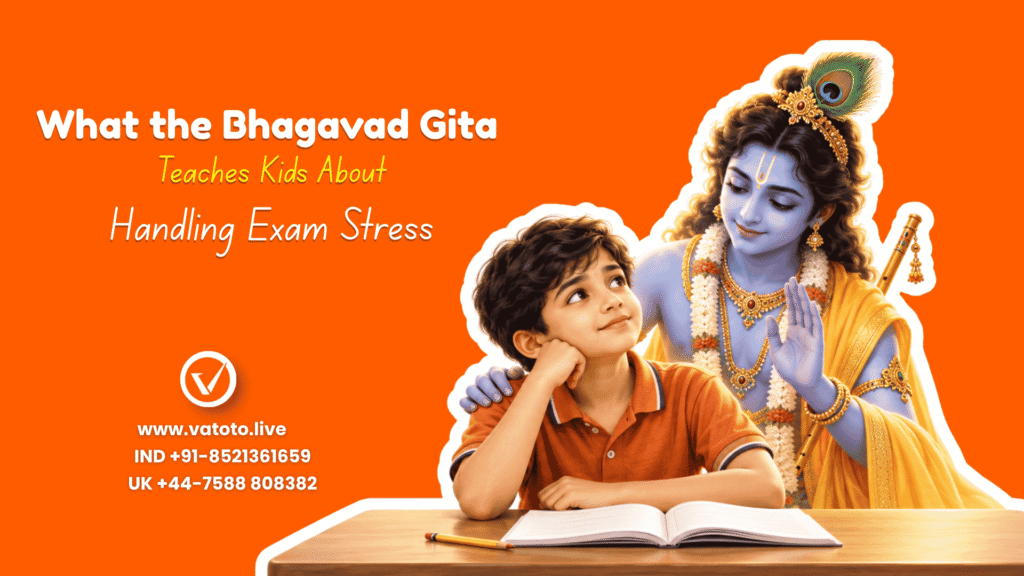
What the Bhagavad Gita Teaches Children About Handling Fear & Pressure
Children today live in a world full of opportunities—but also full of pressure. From a very young age, they are surrounded by expectations. “Perform well in school.” “Be confident.” “Compete with others.” “Make parents proud.” “Keep up with friends.” “Stay strong.”
Many children quietly carry fear inside them.
- Fear of exams.
- Fear of disappointing parents.
- Fear of failure.
- Fear of being judged.
Most adults assume that fear and pressure are problems of grown-ups. In reality, children experience them just as deeply—sometimes even more intensely—because they are still learning how to understand and manage their emotions.
This is where the wisdom of the Bhagavad Gita becomes deeply relevant, even today.
Although written thousands of years ago, the Bhagavad Gita speaks directly to the emotional struggles that children face in modern life. At its heart, it is a conversation about fear, confusion, responsibility, and inner strength—topics every child encounters while growing up.
A Powerful Story of Fear That Children Can Relate To
One of the most striking aspects of the Bhagavad Gita is that it begins not with confidence, but with fear.
Arjun, a highly trained warrior, stands on the battlefield of Kurukshetra. He is strong, skilled, and experienced. Yet, when he sees the situation before him, his mind becomes restless. His body reacts. His heart feels heavy. He feels overwhelmed and unsure.
This moment is incredibly important for children.
It teaches them that fear is not a sign of weakness. Even someone capable and courageous can feel confused under pressure. Fear does not mean something is wrong with you—it means you are human.
Children often believe that “good” or “strong” people never feel scared. The Bhagavad Gita gently breaks this belief. It shows that fear is a natural emotion, and what truly matters is how we understand and respond to it.
Fear Becomes Stronger When We Don’t Understand It
Children usually struggle with fear not because the problem is too big, but because they don’t know how to process what they are feeling.
A child who fears exams may not be afraid of the subject itself. They may be afraid of failure.
A child who avoids speaking in class may not lack knowledge. They may fear judgment.
A child who feels pressure may not be incapable. They may feel overwhelmed.
The Bhagavad Gita teaches that fear grows when the mind becomes restless and confused. When thoughts run in circles, fear multiplies. When emotions are suppressed, pressure increases.
Krishna does not dismiss Arjun’s fear. He does not say, “Stop feeling scared.” Instead, he listens, understands, and guides.
This is a powerful lesson for children: fear is not something to hide or fight blindly. It is something to understand calmly.
Expressing Fear Is the First Step to Strength
One of the most valuable lessons children can learn from the Bhagavad Gita is that speaking about fear is not weakness.
Arjun openly admits that he does not know what to do. He expresses his confusion honestly. This moment teaches children that it is okay to say:
“I am scared.”
“I am confused.”
“I need help.”
Children who are allowed to express fear grow emotionally stronger than those who are told to suppress it. The Gita shows that clarity begins when emotions are acknowledged, not ignored.
This lesson is especially important in today’s world, where children are often expected to “be strong” without being taught how.
Handling Pressure by Shifting the Focus
One of the biggest sources of pressure for children today is constant focus on results.
- Marks.
- Ranks.
- Trophies.
- Comparisons.
Children begin to believe that their value depends on outcomes. This creates fear long before the actual challenge arrives.
The Bhagavad Gita offers a powerful shift in thinking. It teaches the importance of focusing on effort rather than outcome. Children learn that their responsibility is to do their best sincerely, without being consumed by anxiety about results.
This idea may seem simple, but it has a profound impact on a child’s mindset.
When children focus on effort:
- Their anxiety reduces
- Their concentration improves
- Their confidence increases
- Their learning becomes joyful
Pressure decreases when children realise that results are not entirely in their control—but effort always is.
Fear Weakens the Mind, Calm Strengthens It
Another central teaching of the Bhagavad Gita is the importance of a calm and balanced mind.
Fear creates noise in the mind.
Pressure creates restlessness.
Anxiety clouds judgment.
Krishna repeatedly guides Arjun toward inner steadiness. A calm mind allows thoughts to slow down. When the mind is calm, fear loses its grip.
For children, this lesson is extremely practical. A calm mind helps them:
- Think clearly during exams
- Respond instead of reacting
- Handle failure without panic
- Face challenges with confidence
Children who learn to calm their minds early develop emotional stability that supports them throughout life.
Courage Is Not the Absence of Fear
The Bhagavad Gita does not teach children to eliminate fear completely. Instead, it teaches them courage.
Courage means moving forward despite fear.
Courage means taking the right action even when the heart feels heavy.
Courage means trusting oneself during difficult moments.
This lesson is deeply empowering for children. They learn that they do not need to wait for fear to disappear before acting. They can act responsibly even while feeling nervous.
This mindset helps children:
- Attempt new challenges
- Speak confidently
- Try again after failure
- Face difficult situations without avoidance
Pressure Reduces When Self-Worth Is Protected
One of the quiet but powerful teachings of the Bhagavad Gita is that a person’s worth is not defined by success or failure.
Children often internalise failure as personal weakness. A poor grade can make them feel “not good enough.” The fear of this feeling creates enormous pressure.
The Gita teaches that effort, intention, and sincerity matter more than outcomes. This helps children separate who they are from what they achieve.
When children learn this:
- They recover faster from setbacks
- They become emotionally resilient
- They stop fearing mistakes
- They develop healthy confidence
This lesson alone can dramatically reduce pressure in a child’s life.
Discipline Without Fear or Force
Discipline is often misunderstood as strict rules or punishment. The Bhagavad Gita presents discipline as something deeper—self-control guided by awareness.
Children learn that discipline helps the mind stay steady. A disciplined routine creates safety and balance. It does not create fear; it creates clarity.
This understanding of discipline:
- Builds focus naturally
- Reduces chaos and confusion
- Encourages consistency
- Strengthens inner confidence
Children guided by awareness rather than fear grow into self-motivated individuals.
The Importance of Guidance and Support
Arjun does not face his fear alone. He seeks guidance. This teaches children that asking for help is not a weakness.
Parents, teachers, and mentors play a crucial role in helping children navigate fear and pressure. The Bhagavad Gita highlights the importance of having a guide who listens, understands, and offers clarity without judgment.
Children who feel supported develop trust in themselves and others. They handle pressure with greater ease because they know they are not alone.
Why the Bhagavad Gita Is Relevant for Modern Children
Despite being ancient, the Bhagavad Gita addresses problems children face every day:
- Academic stress
- Fear of failure
- Emotional imbalance
- Lack of confidence
- Overthinking
Its teachings are practical and timeless. When explained through stories and real-life examples, children naturally connect with its wisdom.
The Bhagavad Gita does not teach religion alone—it teaches emotional intelligence, resilience, focus, and inner strength.
Teaching the Bhagavad Gita to Children in the Right Way
For children, the Bhagavad Gita should never feel heavy or complicated. The key is how it is taught.
When teachings are shared through stories, discussions, and simple explanations, children absorb them naturally. They begin to apply these lessons in daily life without pressure.
At Vatoto.live, these teachings are introduced in an age-appropriate way through stories, interactive sessions, and meaningful conversations designed to help children grow emotionally and mentally.
From Fear to Confidence: A Lifelong Gift
Fear and pressure will always exist. What changes is how a child responds to them.
The Bhagavad Gita equips children with inner tools:
- Calmness in chaos
- Strength in confusion
- Courage in fear
- Balance under pressure
Children who learn these lessons early do not just perform better academically. They grow into confident, thoughtful, and emotionally strong individuals.
And that strength stays with them—not just for exams or competitions, but for life itself.
Shape Your Child’s Future with Vatoto.live
Live Bhagavad Gita & Hanuman Chalisa Classes for Children
Book a Free Demo Class
Igniting the Spark of Learning