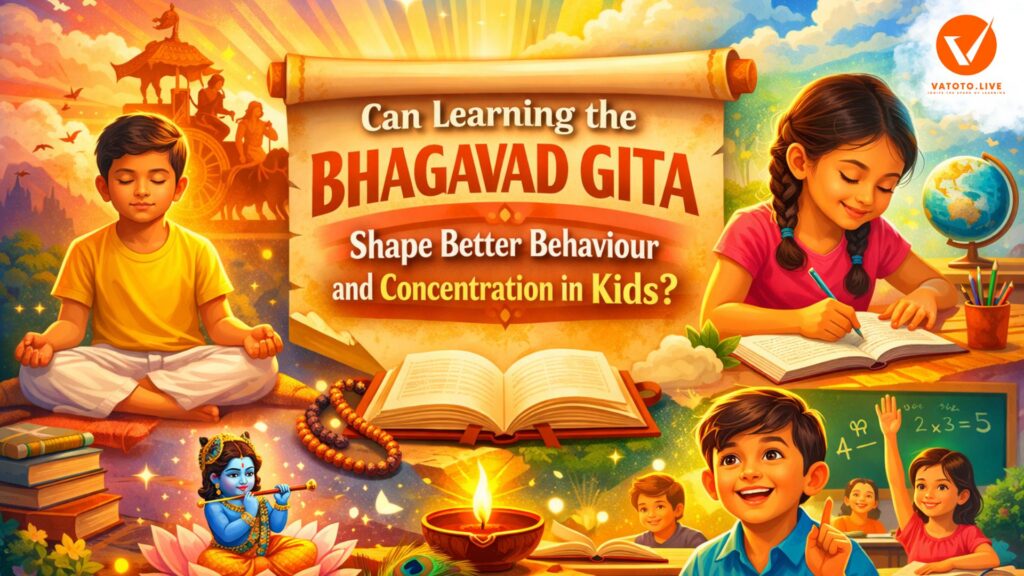
Can Learning the Bhagavad Gita Shape Better Behaviour and Concentration in Kids?
In recent years, many parents have begun noticing a shift in children’s behaviour and attention patterns. While today’s children are exposed to advanced learning tools, digital resources, and global information from an early age, they are also increasingly facing challenges related to emotional regulation, focus, patience, and self-discipline. Complaints such as “my child gets distracted easily,” “my child reacts emotionally,” or “my child struggles to sit still and concentrate” are becoming more common across households.
These challenges are not necessarily signs of poor upbringing or lack of intelligence. Instead, they reflect the reality of growing up in a fast-moving, stimulus-heavy environment where children are rarely taught how to manage their inner world — their thoughts, emotions, and impulses. As a result, many parents are now exploring complementary forms of learning that focus not only on academic success but also on mental balance and character development.
One such approach that has gained attention is introducing children to the teachings of the Bhagavad Gita in a structured, age-appropriate manner. While traditionally viewed as a philosophical or spiritual text, the Bhagavad Gita contains insights that are deeply relevant to modern challenges faced by children. When taught correctly, its principles can support improvements in behaviour, focus, emotional resilience, and overall well-being.
This raises an important question for parents and educators alike: Can Bhagavad Gita classes genuinely help children improve their behaviour and ability to focus?
The Modern Childhood Challenge: Behaviour and Attention
Children today grow up surrounded by constant stimulation — screens, notifications, fast-paced content, academic pressure, and social comparison. Their minds are often required to process multiple inputs simultaneously, leaving little space for reflection, stillness, or emotional grounding. Over time, this continuous mental overload can interfere with a child’s ability to pause, observe, and respond thoughtfully.
As a result, many children begin to display patterns such as:
- Short attention spans and difficulty concentrating on one task
- Impulsive reactions and frequent emotional outbursts
- Reduced tolerance for frustration or delayed gratification
- Anxiety related to performance, comparison, and expectations
- Resistance to routine, discipline, or structured activities
These behaviours are not signs of defiance or lack of capability. In many cases, they indicate that a child’s inner world is overstimulated but under-guided. Children are learning what to think and achieve, but rarely how to manage their thoughts, emotions, and reactions.
While schools rightly focus on cognitive development, academic skills, and measurable outcomes, emotional intelligence and inner discipline often remain secondary. Yet, these inner capacities directly influence a child’s ability to learn, interact positively, and handle challenges with maturity. Without them, even intelligent children may struggle to apply their abilities effectively.
The Missing Link Between Intelligence and Emotional Maturity
A child may be academically capable yet emotionally overwhelmed. This disconnect between intellectual growth and emotional maturity is becoming increasingly visible in modern childhood. When children lack tools to understand their emotions or calm their minds, learning can feel stressful rather than empowering.
Emotional maturity supports essential skills such as:
- Sustained attention and focus
- Self-control and patience
- Thoughtful decision-making
- Healthy responses to failure or success
When these foundations are weak, behaviour and focus often suffer, regardless of academic potential. This is where value-based education systems become relevant—not as replacements for formal education, but as complementary pathways that address the inner development of a child.
Teachings drawn from structured Bhagavad Gita learning aim to fill this gap by helping children build inner clarity, emotional balance, and mindful awareness. By addressing the root causes of distraction and behavioural challenges, such approaches support children in developing not just sharper minds, but steadier and more resilient ones as well.
Understanding the Bhagavad Gita Beyond Religion
The Bhagavad Gita is commonly associated with spirituality or religion, but at its core, it is a dialogue addressing universal human dilemmas — confusion, fear, responsibility, emotional conflict, and purpose. These themes are not limited to adults; children experience them in their own ways every day.
When adapted for young learners, the Gita is not taught as a religious doctrine or philosophical lecture. Instead, its teachings are translated into simple, relatable lessons that children can apply in real-life situations. These lessons often revolve around:
- Understanding and managing emotions
- Staying calm under pressure
- Focusing on effort rather than outcomes
- Acting responsibly and ethically
- Developing inner confidence
Such concepts align closely with modern ideas of emotional intelligence and mindfulness, making the Gita surprisingly relevant for today’s children.
How Bhagavad Gita Classes Can Improve Behaviour
Emotional Awareness and Self-Regulation
One of the most significant benefits of Bhagavad Gita learning is helping children become aware of their emotions. Rather than suppressing feelings like anger, jealousy, or fear, children are taught to recognize them and respond thoughtfully.
Through stories and discussions, children learn that emotions are temporary states, not commands that must be obeyed. This understanding gradually leads to:
- Reduced emotional reactivity
- Improved patience
- Better communication of feelings
- Increased emotional maturity
As children gain control over their emotional responses, their behaviour naturally becomes calmer and more balanced.
Encouraging Responsibility Without Fear
Traditional discipline often relies on external enforcement — rewards, punishments, or strict rules. In contrast, Bhagavad Gita teachings emphasize inner responsibility. Children are encouraged to understand why certain actions are right or wrong, rather than simply being told what to do.
This approach helps children internalize values such as honesty, sincerity, and accountability. Over time, they begin to take responsibility for their actions not out of fear, but out of understanding. This form of self-discipline tends to be more sustainable and deeply rooted.
Developing Empathy and Respect
Behaviour is closely linked to how children relate to others. Gita-based learning often includes reflections on kindness, respect, and the impact of one’s actions on others. By encouraging children to think beyond themselves, these lessons help develop empathy.
As empathy grows, children often become more considerate toward peers, more respectful toward elders, and more cooperative in group settings. These behavioural changes contribute positively to family life and classroom environments alike.
How Bhagavad Gita Classes Support Better Focus
Learning the Power of Focused Action
One of the central ideas in the Bhagavad Gita is the importance of focused action — giving full attention to the task at hand. In an age where multitasking is common, this lesson is particularly valuable.
Children are guided to understand that attention scattered across multiple activities reduces effectiveness, while focused effort leads to better outcomes. With consistent practice, children begin to:
- Stay engaged in tasks for longer periods
- Complete activities they start
- Listen more attentively
Improved focus in everyday activities often extends naturally to academic learning as well.
Reducing Performance Anxiety
Many children experience stress related to expectations — grades, competitions, or comparisons with others. The Gita teaches that while effort is essential, attachment to results can create unnecessary anxiety.
By learning to focus on effort rather than outcomes, children develop resilience. They become more willing to try, make mistakes, and learn from them. Reduced anxiety allows the mind to remain calm and attentive, directly supporting better concentration.
Strengthening Cognitive Skills Through Meaningful Learning
Gita classes often use storytelling, discussion, and reflection rather than rote memorization. This approach engages multiple cognitive processes, including comprehension, memory, and reasoning.
When children understand the meaning behind what they learn, retention improves naturally. This form of meaningful learning supports both focus and long-term cognitive development.
Why Structured Classes Make a Difference
While parents often try to impart values at home, structured learning environments offer consistency and depth that can be difficult to maintain individually. Well-designed Bhagavad Gita classes provide:
- Regular exposure to key principles
- Age-appropriate explanations
- Interactive learning experiences
- Opportunities for reflection and dialogue
Consistency plays a crucial role in turning ideas into habits. Over time, repeated exposure to these teachings helps children internalize values and apply them instinctively.
Alignment with Modern Psychology and Education
Interestingly, many principles found in the Bhagavad Gita align with modern psychological concepts such as emotional regulation, mindfulness, and intrinsic motivation. This alignment explains why Gita-based learning can complement contemporary education systems effectively.
Rather than conflicting with modern values, these teachings reinforce qualities that educators and psychologists recognize as essential for healthy development.
Changes Parents Often Observe Over Time
Parents whose children participate in structured Gita learning frequently report gradual but meaningful changes, including:
- Improved emotional control
- Greater patience and calmness
- Better focus during studies
- Increased sense of responsibility
- Enhanced self-confidence
These changes do not occur overnight, but they tend to be deeply rooted and long-lasting.
Is Bhagavad Gita Learning Suitable for All Children?
Bhagavad Gita learning can be suitable for children of all age groups when it is adapted thoughtfully and presented in an age-appropriate manner. The effectiveness of such learning does not depend on the complexity of the text itself, but on how its ideas are communicated to young minds.
For younger children, learning works best through stories, visual examples, and simple life situations. At this stage, children may not grasp philosophical concepts, but they easily understand emotions, actions, and consequences. Gita-based stories that highlight themes such as kindness, courage, honesty, and self-control help young children internalize values naturally, without feeling overwhelmed or pressured. These lessons often appear as moral narratives rather than formal instruction, making learning enjoyable and meaningful.
As children grow older, their capacity for reflection and reasoning increases. Older children and pre-teens are better able to engage with deeper ideas such as responsibility, self-discipline, decision-making, and emotional balance. At this stage, Bhagavad Gita learning can include guided discussions, question-based reflection, and real-life applications that encourage children to think critically about their actions and choices. Rather than giving fixed answers, this approach helps children develop clarity of thought and personal understanding.
It is also important to recognize that children differ in temperament, learning style, and emotional maturity. Some children connect deeply with stories, while others respond better to discussion or practical examples. Effective Bhagavad Gita education respects these differences and allows flexibility in teaching methods, ensuring that learning remains inclusive and supportive rather than rigid.
When taught with sensitivity, openness, and relevance to everyday life, the Bhagavad Gita becomes more than a text—it becomes a framework for holistic development. It supports emotional growth, ethical understanding, and mental clarity, making it a valuable learning tool for children across different age groups and backgrounds.
Long-Term Impact on Personality Development
Children who are introduced to value-based learning at an early age often develop strong inner foundations that continue to guide them throughout their lives. Rather than reacting impulsively to situations, they learn to pause, reflect, and respond with awareness. This ability to remain internally steady becomes increasingly important as children grow older and face academic pressure, social challenges, and personal responsibilities.
Over time, such children tend to show greater emotional balance, allowing them to handle success and failure with maturity. They are less likely to be overwhelmed by external circumstances because they have learned how to manage their thoughts and emotions from within. This emotional resilience helps them cope better with stress, peer pressure, and uncertainty—common challenges during adolescence and adulthood.
Value-based learning also nurtures focused attention and clarity of thought. Children who learn the importance of mindful effort often carry this habit into their academic and professional lives. They become individuals who can concentrate deeply, make thoughtful decisions, and stay committed to their responsibilities even in demanding situations.
Another lasting impact is the development of ethical awareness and integrity. When children understand the reasons behind right action rather than simply following rules, they are more likely to act responsibly even in the absence of supervision. This inner moral compass supports honest behaviour, empathy, and respect for others—qualities that strengthen relationships and build trust in both personal and professional environments.
As these children grow into adults, the values and mental discipline cultivated early in life continue to influence their choices, relationships, and overall outlook. They are more likely to approach life with confidence, self-awareness, and a sense of purpose, making value-based learning not just a childhood experience, but a lifelong asset.
Final Thoughts
So, can Bhagavad Gita classes improve children’s behaviour and focus? When taught in a thoughtful, age-appropriate, and structured manner, the answer is yes. Rather than enforcing discipline from the outside, such learning nurtures inner clarity, emotional balance, and focused effort.
In a world that increasingly demands speed and performance, helping children cultivate calmness and self-awareness is an investment in their long-term well-being. Platforms that aim to present such wisdom in a child-friendly way, including Vatoto.live, reflect a growing recognition of the importance of holistic education alongside academics.